LMH Onken
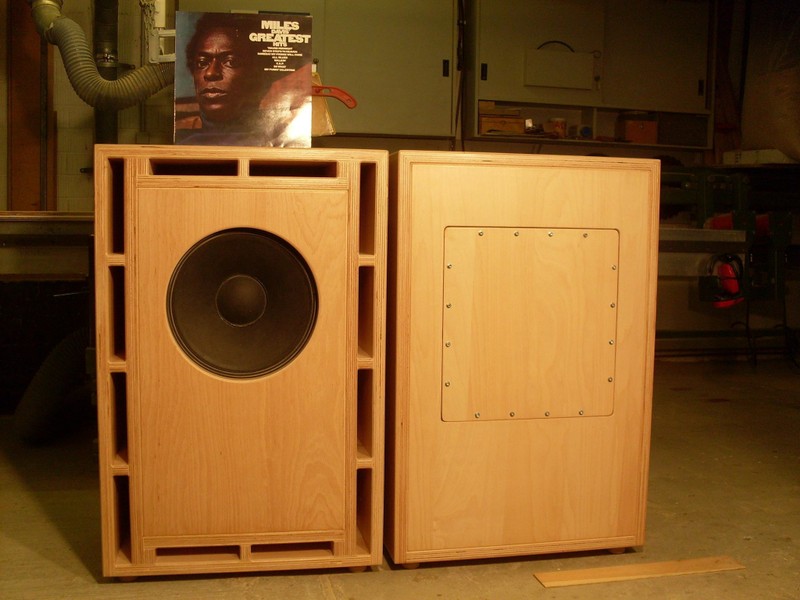
A classic Onken bass reflex system.
Large internal volume, generously dimensioned port area, and controlled low-frequency reproduction — precisely executed in the LMH manufactory.
.

Concept
The Onken principle is a specialized form of bass reflex design in which a large cabinet volume is deliberately combined with a very large total port area.
In contrast to compact bass reflex enclosures, an Onken system operates with low air velocity in the ports and reduced acoustic compression.
The objective of this principle is not maximum low-frequency extension on paper, but a stable, well-structured low-frequency reproduction with high consistency and clean time behavior.
Thanks to the large internal volume, the woofer can operate with reduced cone excursion, which lowers distortion and improves transient response.
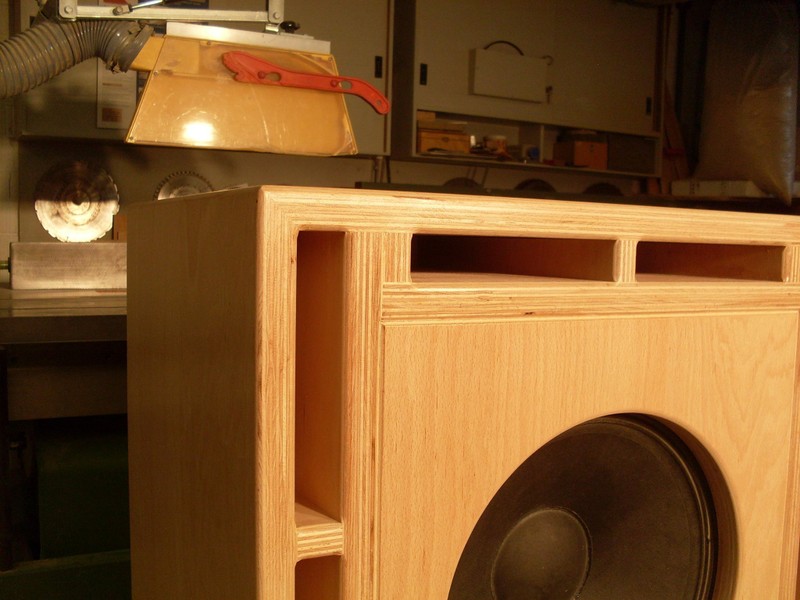
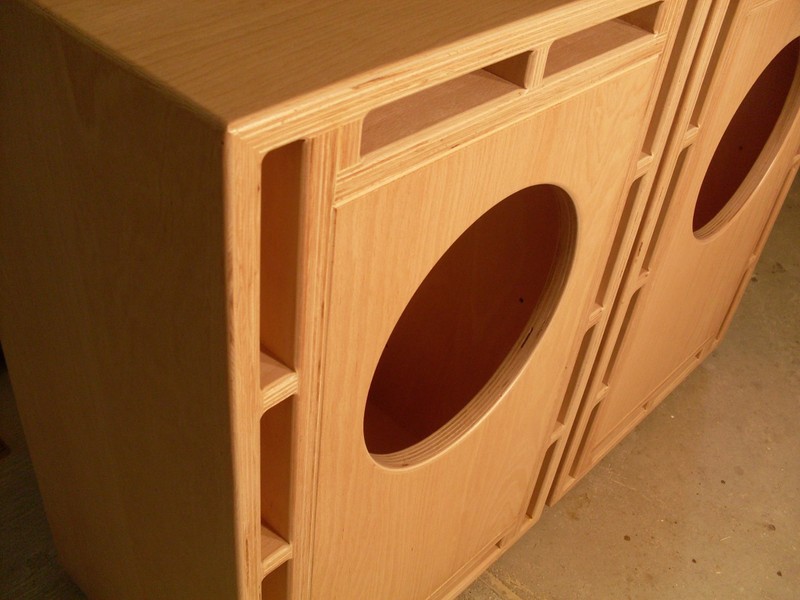
A defining feature of the Onken system is the use of multiple wide slot ports, allowing low-turbulence coupling to the surrounding air.
Within its operating range, the bass presentation remains open, controlled, and unstrained — without thickening or compression at higher sound pressure levels.
Port geometry and defined tuning
Tuning follows the Helmholtz resonance principle. In simplified form:
Where is the total port area (sum of all slot ports), the net internal volume, and the effective port length including end corrections.
The characteristically large port area of the Onken design reduces air velocity and compression, but requires precisely defined port lengths and clean transitions to achieve a reproducible and well-controlled tuning.
Historically, the Onken principle has been primarily used with high-quality 12″ and 15″ drivers and was often combined with horn systems.
Its high efficiency and clean lower midrange behavior make it particularly suitable as a bass or bass / lower-midrange foundation in classic multi-way loudspeaker concepts.
The LMH interpretation of the Onken principle deliberately relies on defined geometries and reproducible design parameters.
Cabinet volume, port area, and tuning follow a clear acoustic logic and are not scaled arbitrarily. This results in a system that can be integrated predictably and delivers stable, long-term performance.
The Onken is therefore not an effect-driven enclosure, but a functional tool for realizing controlled, authoritative low-frequency reproduction — designed for substance, not for spectacle.


Manufacturing & materials
The manufacturing of the LMH corner horn takes place entirely in the LMH manufactory and follows a clear technical logic: mechanical stability, reproducible acoustic behavior, and structural integrity are the primary objectives.
All structural and acoustically relevant components are first CNC-machined and subsequently finalized by hand.
The goal is not surface perfection at any cost, but a precise and repeatable realization of the acoustic geometry — as even deviations in the millimeter range can measurably influence radiation behavior and low-frequency performance.
For the cabinet and internal horn paths, high-quality wood-based materials are used, primarily European birch plywood and — depending on the version — solid wood.
These materials offer a balanced combination of high mechanical stiffness and internal damping, which is particularly advantageous in large-volume horn constructions.
For customers with the highest technical demands, this Classic model is also available in a no-compromise Panzerholz version — maximizing material quality, mechanical calmness, and long-term dimensional stability, without regard to effort or weight.
Wall thicknesses are deliberately generous.
Mass and stiffness serve solely to reduce structural resonances and to create a mechanically stable working environment for both the driver and the enclosed air volume.
Resonances are not corrected electronically, but prevented through construction.
Particular attention is paid to the internal structure of the corner horn:
-
Folded horn paths, deflections, and transitions are manufactured precisely according to CAD data.
-
Edges, radii, and transition surfaces are designed to minimize unwanted reflections and localized resonances.
-
Bracing and internal connections are functionally placed to increase structural stiffness without interfering with the acoustic path.
Surface finishes, wood species, and constructional details are defined on a project basis — not as cosmetic variations, but as an integral part of the functional design.
The result is a corner horn that is not defined by nostalgia or visual effects, but by acoustic substance, technical consistency, and long-term stability.
Who is the Onken designed for?

LMH Classic Line
High-frequency horn


System Architecture
The LMH Onken systems are manufactured in three defined versions and are available either as cabinet-only units or as fully matched complete systems including the low-frequency driver.
In the complete system configuration, driver, cabinet volume, and port geometry are designed as a coherent unit and precisely matched to one another.
High-quality low-frequency drivers in the 12″, 15″, and 21″ size classes are used, specifically selected for operation in large-volume, low-velocity bass reflex systems.
Driver selection is not brand-driven but parameter-based — including resonance frequency (Fs), total Q (Qts), equivalent air volume (Vas), and mechanical power handling.
In the complete system version, final tuning is carried out on a project-specific basis.
Tuning frequency, port length, and damping are defined to achieve a controlled, well-structured low-frequency response that integrates seamlessly into high-quality multi-way loudspeaker systems.
Depending on the application, the Onken system can be used either as a dedicated bass module or as a bass / lower-midrange foundation.
Thanks to its high efficiency and clean lower-midrange behavior, combination with horn systems in the mid and high frequency ranges is particularly well suited.
The system is deliberately not optimized for maximum low-frequency extension figures, but for authority, control, and reproducible time behavior under realistic operating conditions.
The Onken thus functions as a purposeful element within a complete system — not as an effect-driven enclosure.

Design Driven by Acoustics
At LMH, design consistently follows acoustic function.
Material selection, surface treatment, and construction are not decorative elements, but integral parts of the mechanical and acoustic design.
Solid Wood – Where It Makes Sense and Remains Stable
Where it is structurally and acoustically meaningful, we also build enclosures from carefully selected solid woods.
We use only woods with proven long-term stability, defined density, and good internal damping, such as:
-
Beech
-
Maple
-
Oak
-
Ash
-
Walnut
-
Selected tropical hardwoods (project-dependent)
Solid wood is used deliberately – not universally – only where mass, stiffness, and resonance behavior benefit from it and where climatic influences remain controllable.
Veneer on Plywood – The Technically Preferred Solution
In many cases, veneered plywood is the acoustically and mechanically superior solution.
As a core material, we use high-quality beech or birch plywood with excellent dimensional stability and uniform resonance behavior.
This core is finished with real wood veneers in virtually any available species – chosen for visual reasons without sacrificing the structural advantages of plywood.
This construction offers:
-
High long-term stability
-
Low tendency to warp or crack
-
Reproducible acoustic properties
-
Free choice of wood appearance without structural drawbacks
At LMH, veneer is not a compromise, but a deliberately chosen high-end solution.
Stains & Wood Surfaces
Wherever possible, the natural wood structure remains visible.
We use:
-
Transparent stains to emphasize the grain
-
Oil and hardwax systems for open, lively surfaces
-
Satin-matte lacquers with minimal film thickness
Surface finishes are defined on a project basis, matched to wood species, geometry, and acoustic targets.
Paint Finish (Optional)
Where it makes sense from a design or conceptual perspective, fully painted versions are also possible.
-
Color selection in nearly all RAL shades
-
Opaque or satin finishes
-
Multi-layer, mechanically stable paint systems
At LMH, painted finishes are not a standard solution, but a consciously chosen alternative to wood or veneer surfaces.
Project-Specific Configuration
Every LMH product is configured on a project-specific basis.
Wood species, veneer, stain, or paint finish are integral parts of the overall design – not interchangeable accessories.
The goal is a permanently stable, mechanically quiet, and visually honest system that does justice to the respective loudspeaker or enclosure concept.
System
-
Classic corner horn loudspeaker system
-
Use of the room corner and adjacent walls as an acoustic extension of the horn
-
Focus on high efficiency, controlled radiation, and solid low-frequency performance
Driver configuration
-
15″ low-frequency driver
-
Project-based driver selection in consultation with the customer
-
Driver recommendations based on room size, placement, and target performance
-
Available as cabinet only or as a complete system including drivers
Horn path & tuning
-
Folded internal horn path with defined expansion geometry
-
Acoustic extension of the horn via the room corner
-
Very high efficiency with low acoustic compression
-
Tuning optimized for the 15″ driver class and typical placement conditions
Operation
-
Passive or active operation possible
-
Particularly suitable for high-efficiency systems
-
Well suited for tube amplifiers and low-power amplification
Structural characteristics
-
Precisely engineered horn geometry
-
Defined wall thicknesses and rigid internal structure
-
Mechanically calm, low-resonance construction
-
Reproducible manufacturing
Dimensions & weight
-
Approx. 85 × 102 (plus HF section) × 75 cm (W × H × D)
-
Approx. 90–120 kg
This Classic model is also available in a Panzerholz version for customers with the highest technical and mechanical demands.
Dimensions and weight may vary depending on driver selection, horn geometry, wall thicknesses, placement conditions, and surface finish.
Pricing
Cabinet: from €2,000 per unit
Complete systems: from €6,500 per pair
Pricing depends on version, edition, wood selection, and technical configuration.
Inquiry & configuration
Each Onken cabinet is manufactured on a project basis.
Following your inquiry, we discuss version, surface finish, and technical options and provide a non-binding quotation.